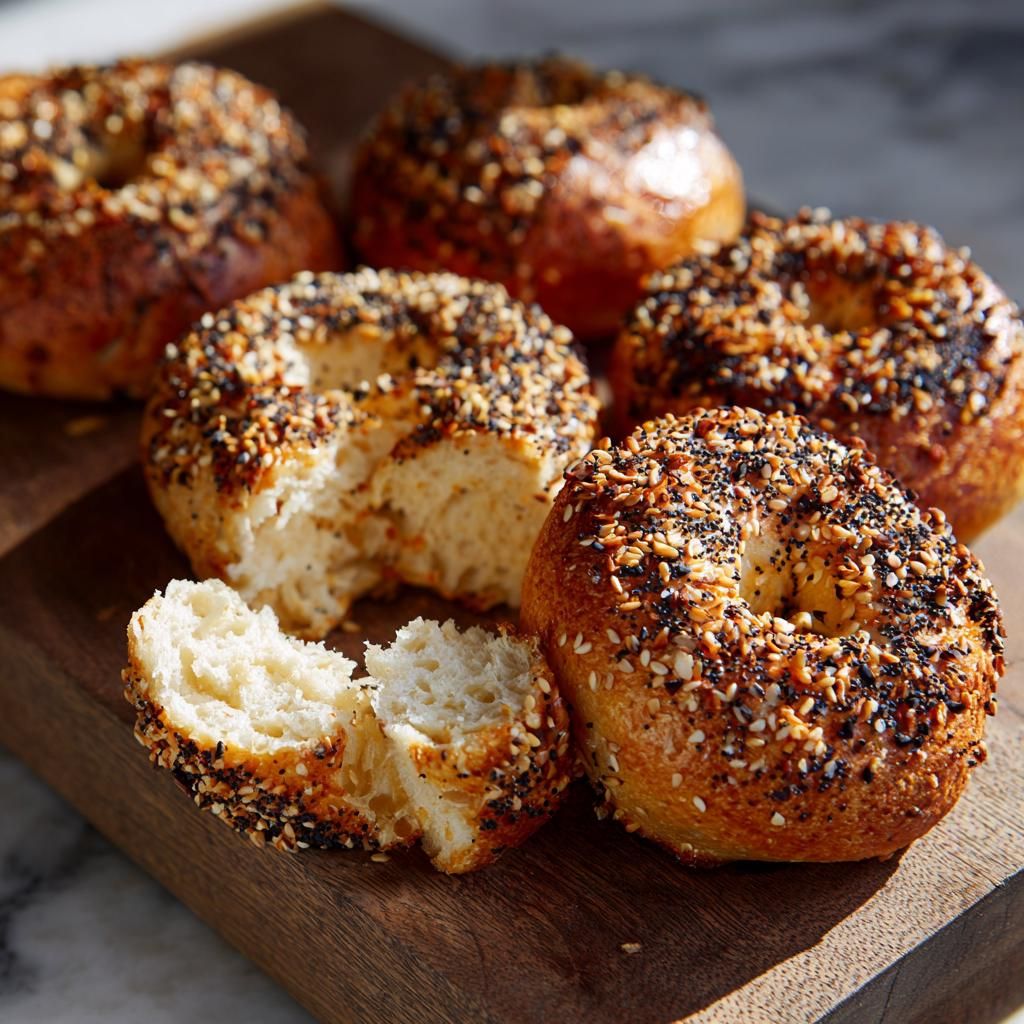
Sourdough bagels are chewy, flavorful, and wonderfully satisfying. They have a golden, slightly crisp exterior and a dense but tender interior with the characteristic chewy texture that makes a great bagel so irresistible. Naturally fermented with sourdough starter, these homemade bagels have a subtle tang and rich flavor that you simply cannot get from many store-bought versions.
Although bagels require a few extra steps compared with ordinary bread, the process is straightforward. The dough is mixed and fermented, shaped into rings, briefly boiled in water, and then baked until beautifully golden. You can enjoy them plain or customize them with sesame seeds, poppy seeds, everything seasoning, cheese, or your favorite spreads.
Recipe Details
Prep Time: 30 minutes
Fermentation Time: 8–12 hours
Second Rise: 1–2 hours
Boiling Time: 1–2 minutes per bagel
Bake Time: 20–25 minutes
Total Time: About 11–16 hours
Yield: 8 bagels
Servings: 8
Ingredients
For the Dough
- 4 cups bread flour
- 1 cup active sourdough starter
- 1¼ cups lukewarm water
- 2 tablespoons honey or sugar
- 1½ teaspoons salt
- 1 tablespoon olive oil or neutral oil
For the Boiling Water
- 8 cups water
- 1 tablespoon honey, sugar, or barley malt syrup
- 1 teaspoon baking soda, optional
For Topping
- Sesame seeds
- Poppy seeds
- Everything bagel seasoning
- Dried onion
- Dried garlic
- Shredded cheese
- Coarse salt
You can use one topping or combine several to create your favorite flavor.
Equipment
- Large mixing bowl
- Kitchen scale, if available
- Baking sheet
- Parchment paper
- Large pot
- Slotted spoon
- Wire cooling rack
- Clean kitchen towel
Step 1: Prepare the Sourdough Starter
Use a strong, active sourdough starter for this recipe.
Feed the starter several hours before beginning and allow it to become bubbly and active. Ideally, it should rise noticeably after feeding and have a pleasant fermented aroma.
An active starter is important because bagel dough is relatively firm and requires enough fermentation strength to rise properly.
Step 2: Mix the Dough
Add the lukewarm water, active sourdough starter, honey, and olive oil to a large mixing bowl.
Stir until the starter is mostly dissolved.
Add the bread flour and salt.
Mix everything together with a wooden spoon or your hands until a rough dough forms.
The dough should feel firm rather than wet and sticky. Bagel dough is intentionally lower in hydration than many other sourdough recipes.
Step 3: Knead the Dough
Transfer the dough to a lightly floured work surface.
Knead for approximately 8–10 minutes until the dough becomes smooth, elastic, and firm.
You can also use a stand mixer fitted with a dough hook. Mix on low to medium speed until the dough becomes smooth and pulls together.
Because this is a firm dough, it may require some effort to knead by hand.
Avoid adding too much flour. If the dough feels dry, allow it to rest for 5–10 minutes before deciding whether it needs additional water.
Step 4: Bulk Fermentation
Place the kneaded dough into a lightly greased bowl.
Cover it with plastic wrap, a lid, or a clean kitchen towel.
Allow it to ferment at room temperature for approximately 8–12 hours.
The dough does not need to double in size. Instead, look for a noticeable increase in volume and a smoother, slightly puffy appearance.
Fermentation time depends heavily on room temperature and starter activity.
A warm kitchen will speed up fermentation, while a cooler kitchen will require more time.
Step 5: Divide the Dough
Once the dough has fermented, transfer it to your work surface.
Divide it into 8 equal portions.
Using a kitchen scale is helpful because evenly sized bagels will cook at the same rate.
Shape each portion into a tight ball.
Cover the dough balls with a clean towel and let them rest for approximately 10–15 minutes.
Step 6: Shape the Bagels
There are two easy ways to shape bagels.
The first method is to poke your thumb through the center of each dough ball and gently stretch the opening until it is about 1½–2 inches wide.
The second method is to roll each dough portion into a rope, approximately 8–10 inches long. Wrap the rope around your hand and overlap the ends underneath your palm. Pinch the ends firmly together.
Whichever method you choose, make sure the center hole is reasonably large because it will shrink during boiling and baking.
Place the shaped bagels on a parchment-lined baking sheet.
Step 7: Second Rise
Cover the shaped bagels loosely with plastic wrap or a clean kitchen towel.
Let them rest at room temperature for approximately 1–2 hours.
They should look slightly puffier but should still maintain their shape.
For more developed flavor, you can refrigerate the shaped bagels overnight instead of doing a long room-temperature second rise.
If refrigerated, allow them to sit at room temperature for a short time while you prepare the boiling water.
Step 8: Prepare the Boiling Water
Fill a large pot with approximately 8 cups of water.
Bring it to a gentle boil.
Add the honey, sugar, or barley malt syrup.
You can also add a teaspoon of baking soda for a slightly deeper color and more pronounced crust.
The sweetener helps encourage browning and contributes a subtle flavor to the finished bagels.
Step 9: Boil the Bagels
Carefully place 2–3 bagels into the boiling water at a time, depending on the size of your pot.
Do not overcrowd the pot.
Boil each bagel for approximately 30–60 seconds per side.
For chewier bagels, boil closer to 60 seconds per side. A shorter boiling time will generally produce a slightly thinner crust.
Use a slotted spoon to remove the bagels and place them back onto the parchment-lined baking sheet.
Repeat with the remaining bagels.
Step 10: Add the Toppings
Immediately after boiling, sprinkle your desired toppings over the bagels while their surfaces are still wet.
Try sesame seeds for a classic flavor, poppy seeds for a nutty crunch, or everything seasoning for a savory combination.
For cheese bagels, sprinkle shredded cheese over the top.
Press toppings gently if necessary so they adhere to the surface.
Step 11: Bake the Bagels
Preheat your oven to 425°F (220°C).
Place the baking sheet in the oven and bake for approximately 20–25 minutes.
The bagels should become golden brown with a firm, slightly crisp exterior.
For even browning, rotate the baking sheet halfway through baking.
Once finished, remove the bagels from the oven and transfer them to a wire rack.
Allow them to cool for at least 15–20 minutes before slicing.
Tips for Perfect Sourdough Bagels
Use bread flour: Higher-protein flour helps create the chewy texture associated with traditional bagels.
Keep the dough firm: Bagel dough should be much less wet than typical sourdough bread dough.
Build good gluten strength: Thorough kneading helps the bagels hold their shape during boiling and baking.
Do not overproof: Over-fermented bagels can become flat and lose their characteristic chewiness.
Make the holes large: The center opening will shrink during boiling and baking.
Boil before baking: This step creates the distinctive chewy crust and shiny exterior.
Use an active starter: A weak starter may take considerably longer to ferment the dough.
Flavor Variations
Sourdough bagels are easy to customize.
For cinnamon raisin bagels, gently fold in raisins and cinnamon during the final stage of dough mixing.
For chocolate chip bagels, add mini chocolate chips.
For savory bagels, mix shredded cheddar, Parmesan, or herbs into the dough.
You can also create jalapeño-cheddar bagels by adding finely chopped jalapeños and shredded cheddar cheese.
For a sweeter option, add dried cranberries and orange zest.
Serving Suggestions
Slice your cooled bagels in half and toast them until lightly crisp.
Classic toppings include cream cheese, butter, jam, honey, or peanut butter.
For a filling breakfast, add scrambled eggs, cheese, and cooked vegetables.
You can also create delicious lunch sandwiches with turkey, chicken, tuna, cheese, lettuce, tomato, and your favorite sauce.
Everything-seasoned sourdough bagels are particularly delicious with cream cheese and sliced cucumber.
Storage
Store completely cooled bagels in an airtight container or bread bag at room temperature for up to 2–3 days.
For longer storage, slice the bagels before freezing so they can go directly into the toaster.
Place them in a freezer-safe bag and freeze for up to 3 months.
To serve, toast the frozen bagel directly or allow it to thaw first.
